Hello everyone!!
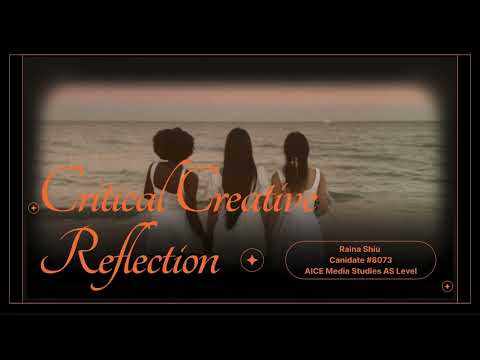
Today is a sad day; the daily or weekly updated blogs about my film opener and project for AICE Media Studies have officially come to an end. I am super sad that the journey of sharing my progress on my movie opener project has ended. You guys have gone through with me both the easy times and the tough times of this process, from pre-production (planning hair, costumes, settings, and props) to filming, to editing, and final touches. Unfortunately, all good things eventually come to an end. Therefore, the only right way to end this journey with you guys is, of course, by reflecting and evaluating my process. This final blog will be me presenting my critical creative reflection, or CCR. This critical creative reflection is essentially me going into depth and reflecting back fully on the whole process. Some of the things in my CCR were brought up in my blogs; however, my CCR goes even more into detail, so I hope you can stay by and watch it through fully! My critical creative reflection is in the form of a PowerPoint or Canva presentation. This PowerPoint includes pictures and videos throughout and contains a voiceover of me presenting it. Once again, I am extremely grateful that you guys followed along this journey with me, as you guys are one of my biggest supporters! Attached down below will be my critical creative reflection video, as well as a transcript, so that you can easily follow along with what I say and not get lost.
Slide
1: Hello! My name
is Raina Shiu, candidate 8073, and this is my critical creative reflection for
my film opener called Along the Way.
Slide
2: Along the Way
is a film that captures how grief reroutes the journey of friendship. After the
devastating loss of their best friend, Jahzara, three teenagers—Raina, Emi, and
Ngoc—find their once unbreakable bond beginning to fracture. As each girl copes
in her own isolating way, through performance, withdrawal, or peacekeeping,
they discover that the hardest part of losing someone can be losing each other
along the way. The film is a quiet, but visual exploration of memories and
lonely paths walked after a shared tragedy.
Slide
3: Question 1, how
does your product use or challenge conventions and how does it represent social
groups or issues?
Slide
4: Our film, along
the way, operates within the genre of drama and subgenre of coming of age by
utilizing many of its core conventions to set up a story that it ultimately
subverts. First, we embrace key conventions to establish the scene. The narrative
of my movie opener is built around a life changing event or tragedy—the death
of a friend—which is a classic conflict in this genre. The film also utilizes
the central convention of self-discovery and identity formation. I focused
mainly on the emotional and psychological growth of the protagonists. Each
character is on a raw, vulnerable journey to figure out who they are in the
devastating absence of their best friend. Raina’s identity fractures into a
performative façade, Emijola’s fades into a shadow of her former self, and
Ngoc’s becomes defined by a burdensome role she never chose. Visually, I used
conventions like montage sequences to show the passage of time in the bedroom
and symbolic settings such as the melancholic beach or the sterile school
setting to help portray the characters’ internal states.
Slide
5: However, our
film also challenges some of the coming-of-age drama genre core narrative
conventions. Traditionally, films within this genre use tragedy as a way to
unite and create a stronger bond between the protagonists. They typically bring
them closer together by sending them on a shared journey of healing or revenge
that ultimately strengthens their bond. However, my movie opener subverts this
convention by suggesting that self-discovery can sometimes mean discovering an
isolating and fractured version of yourself. Instead of the tragedy enforcing a
stronger group identity, it shatters all three protagonist’s sense of self. We
portrayed this by using the five stages of grief across the friends. Raina is
trapped in denial, Emijola in depression, and Ngoc in bargaining. Their
individual identity in the face of grief is what traps them from healthy
communication and understanding. The conventional journey ends not in a
stronger bond, but in separation, which is shown as they walk away from each
other on the beach.
Slide
6: Our film
represents a variety of social groups and issues to create a narrative that is
both specific in its identity and universal in its emotional core. Race and
ethnicity are shown through the diverse friend group. The characters are Chinese
American, Vietnamese-American, Jamaican-American, and Haitian/Nigerian
American. This was a deliberate choice to reflect on modern friendships. Moreover,
gender is centered on teenage girls. The story focuses on female friendship and
the pressures they often face from society. For example, Raina endures the
pressure to be the happy social butterfly but clearly, she undergoes a
suffocating façade. Likewise, Ngoc embodies the expectation for women to be the
nurturing peacekeeper whose role as the groups’ emotional stabilizer leaves her
burdened. Emijola however, subverts the expectation that female grief should be
openly expressive. Her depression is heavy, but silent, as she withdraws
mentally and physically, which challenges the idea of how a “sad girl” should
look.
Our film
directly represents and brings awareness to the issue of mental illness by
moving past the typical stereotypes. Emijola’s struggle is not represented as a
mere sadness or cry for help that can be easily solved with simple pep talks,
but rather as an isolating force and extremely consuming health condition that
alters her behavior and self-identity. In other words, this challenges the
societal expectation that people should quickly get over grief. Another core
issue addressed is the idea of love and death. Our film explores how death is not
an end to love, but a transformation of it. The unconditional love that the
three friends have for Jahzara does not disappear, but it becomes a heavy
burden on them.
Slide
7: Question 2, How
does your product engage with audiences and how would it be distributed as a
real media text?
Slide
8: Our film opener
grabs the audience’s attention first through its striking contrast. The opening
beach scene at sunset is immediately beautiful and solemn, using soft, warm
light to create a sense of peace and deep sadness. This draws the audience in
with a feeling of intimacy and emotions. What makes the audience stay to watch
is the relatable actions of each character. People watching connect with the
three girls and recognize the different, flawed ways they cope with
grief—through denial, depression, or trying to simply hold everything together.
The tension is created from wondering whether their friendship will survive and
overcome the grief or not. In order to WOW the audience, our film relies on aesthetic
cinematography and emotional authenticity. The beach scene was carefully
composed. It was specifically captured at sunset with the golden hour lighting,
the slow arc shot around the characters, and the poetic moment of ash
scattering. These visual choices impact our film’s emotional theme. The
audience is able to connect with the raw and heartbreaking emotions each
character is enduring in a relatable way.
Slide
9: If Along the
Way were a full film, my ideal path would be for it to reach a wide audience of
young children, teens, or families who connect with emotional, character
development driven stories. To do that, my goal would be for the film to reach
a major streaming platform such as Netflix and Disney+. Likewise, to produce
it, it would be produced under Netflix Studios or Walt Disney Studios. Under
these studios, there will be professional producers, directors, and specialists
in film guiding the project. They would be able to help expand the story/narrative
and ensure overall higher production quality. Once production is completed, before
fully releasing it, the next critical step would be marketing.
Slide
10: For marketing,
I would form a promotional partnership with a music artist such as Billie
Eilish as she is an active influential figure that advocates mental health
awareness. This perfectly aligns with the film’s themes. She could contribute
an original song for the soundtrack. Her involvement would help promote the
movie to her large fan base. Another way the movie will be marketed is through interviews
with talk shows. For example, the cast would be booked for the Jimmy Fallon
Show or the Kelly Clarkson Show as these talk shows are perfect for the
audience to get to know the actors better personally, and to be able to see the
behind the scenes which adds authenticity. Last but not least, once marketing is
completed, the movie will be released as a Netflix Original or under Disney+ to
maximize the audience it reaches as these are already big streaming platforms.
Slide
11: Question 3,
how did your production skills develop throughout this project?
Slide
12: Throughout
this process, my production skills have improved significantly in terms of
learning different techniques. Such skills include learning how to download and
extract audios, importing fonts, adding transitions to fonts, and changing
saturations/contrasts.
Slide
13: Starting with
learning how to download and extract audios. When I first started helping with
my group to edit, I was completely clueless on how to import an audio from a
recording without the recording showing on the actual movie. I learned through
my friend Emijola, that there was a feature on an app called CapCut where it
allows you to upload any video and it will automatically extract the audio for
you.
Slide
14: Another skill
I learned was how to import fonts. I already knew that most editing platforms
had preset fonts that you could use, but I never knew how other people could
get cool and amazing fonts that were not on the app itself. I decided to
research on my own and found out about a website called “dafont.com.” This
website has a variety of unique fonts that are created by a variety of
different people. I now know that you can download the file of the font on the
website to your device and then import the file onto the editing software.
Slide
15: Another skill
I acquired was in learning to add transitions to fonts specifically. I already
knew how to do the basics such as adding transitions between clips. However, I
had always wondered how people were able to get texts to transition smoothly
from one shot to another. I did not learn until another friend of mines, told
me that there was a hidden feature also on Capcut called “animations.” This
animations feature allows you to put both intro and outro transitions, such as
fade ins and fade outs, and it is shown in the video here.
Slide
16: Another skill
I gained from this process was effectively changing saturations of clips. I
knew of the concept that you could change saturations and contrasts of clips.
However, I never understood the concept behind it. Whenever I changed those
settings, the clip would look weird and either too saturated, or too
contrasted. However, I have a friend who took art that was able to teach me the
difference between saturation and contrast. By teaching me the difference
between the two, I was able to learn how to effectively incorporate both
settings into our film opener. The scenes were transformed into a dull
aesthetic to a more vibrant and color-popping aesthetic. The difference is
subtle, but still visible and creates a difference.
Slide
17: Here is a
visual comparison of the two shots before and after editing the saturations and
contrasts. As you can see the before has a grey tone to it that makes it look
dull, whereas the after shows the intense coloring of the sunset and adds a
warmer tone to the shot.
Since
starting the process of researching, filming, and editing, I have grown
significantly as a filmmaker when it comes to editing. I have always liked the
process of recording itself, but I was not originally a fan of editing as I was
not good at it. However, after finishing the movie, I have developed an
interest towards editing as I have gotten better at it due to my amazing
friends and of researching on my own. I would not consider myself to pursue an
editing career in film, but I believe that it is a talented industry with
extremely creative individuals.
Slide
18: Question 4,
how did you integrate technology software, hardware and online—in this project?
Slide
19: In this
project, I have learned how to maximize the use of technology to my own
advantage. In this age, it is no shocker that the use of technology is
everywhere. Throughout the whole process, technology was a crucial essential. I
was able to learn how to use the cinematic mode on the iPhone 14 pro max to
record. This mode allowed my group to create a variety of depth of fields in
our movie to draw the audience into key emotional moments without the need for
a professional camera such as a Canon.
Slide
20: For editing,
we used the editing software called Capcut which had so many features that it
allowed us to have a smooth editing process. It was extremely easy to upload
clips onto the app. We simply had to go on the app and click import, then we
could upload whatever clip that was already recorded in our photos or files. The
app also had a variety of transitions, both clip transitions and text
transitions, that were easy to add. The app featured a range of sound effects,
preset fonts, and ability to adjust colors and apply filters. The best feature
had to be of course that it was free! The app required no purchase fee to use
it. The app offered a pro version that did cost money, however, that was not
needed because the free version already contained a variety of features.
Overall, CapCut was an amazing editing software that made me more confident in
my abilities to edit since it was beginner friendly or easy to learn how to
use.
Slide
21: Another
software I have used throughout this process is a website called Blogger.com.
Since starting AICE Media Studies, Blogger was an important website where I
wrote daily blogs to document my entire journey of the movie opener project, from
initial research to final reflections. Each blog contains information or
updates about every step I took to make this project possible with my group. These
blogs helped me organize my thoughts like a personal journal or diary.
Slide
22: Overall, our
project, Along the Way, was a thought-out process that took time and
dedication. I am extremely grateful for the experience and skills I was able to
gain from this process. I have learned to appreciate the art of filmmaking and
understand that it is not just a process of writing a script and hitting
record, but a meticulous thought-out process that requires creativity,
collaboration, and effort. I now understand how every choice, from the color of
the wall to the characters themselves, plays an important role in building the
story’s emotional world. This journey has not only taught me the filmmaking process
but also shown me how to tell stories on a deeper level.
Slide
23: Thank you
everyone for listening, this is my critical creative reflection on my film
opener, Along the Way.



No comments:
Post a Comment